
Yazoo Regional Release Paths
Yazoo Regional Correctional Facility has a hybrid role. The official MDOC facility page describes a regional institution operated through the Yazoo County Sheriff under state oversight. It houses contracted adult male MDOC prisoners, yet local records can also lead a person to the Sheriff or facility. That means the building name alone does not identify which agency owns the final release record.
A county custody episode may end in bond, dismissal, time served, delivery to MDOC, or a move to another authority. The Sheriff’s jail docket should state how the person was released or discharged and identify a receiving agency when custody continued. An MDOC episode follows another route. A parole release, earned-release placement, state discharge, or unit transfer belongs in MDOC time and movement records. The same person may even remain in Yazoo County while the legal custodian changes.
Confirm Yazoo Regional Releases
Begin with the full name, date of birth, booking date, and any booking or MDOC number. Ask which custody episode is at issue. Public sources do not establish that every ordinary Yazoo pretrial detainee is held in this exact building, so confirm the person and booking with facility staff rather than assuming a shared location.
- Call the facility and ask whether the person was held as a local detainee or an MDOC prisoner.
- For a local episode, request the jail-docket entry, effective release or movement time, release wording, authority, and destination.
- Obtain the matching Justice, County, or Circuit Court order to learn the legal basis for the action.
- For an MDOC episode, search by MDOC number or name, then compare birth date, conviction county, sentence, location, and location-change date.
- Ask MDOC Records for the time sheet and signed release or discharge record when the public result is unclear.
The full named-person fallback across Yazoo systems is explained in the Yazoo County released inmate search. A current roster answers who is confined now. It is not a history of people who already left, and a vanished entry does not prove how the custody episode ended.
Note: Match the booking or MDOC number before relying on a shared name, photograph, or estimated date.
Yazoo Regional Release Contacts
Facility administration is the first contact for the physical placement and local movement record. The Sheriff is the county jailor and keeper of the jail docket. MDOC Records owns the state sentence, time computation, and state discharge record. Hours were not published in the reviewed sources, so call before visiting.
Yazoo Regional Correctional Facility
154 Roosevelt Hudson Drive
Yazoo City, MS 39194
Phone: 662-751-8484
MDOC Records
P.O. Box 24388
Jackson, MS 39225
Phone: 601-933-2889
Email: MDOCRecordsDepartment@mdoc.state.ms.us
For a county record, ask the Yazoo County Sheriff for the existing booking, movement, and jail-docket history. Name the specific booking and seek the admission time, effective release time, exact manner of release or discharge, court authority, bond disposition, holds, and receiving agency. For state custody, request the public time sheet and actual release or discharge certificate instead.
Yazoo Regional Facility Record
The 2020 regional audit describes a county-owned and county-operated medium-custody facility that opened in 2010. It reported four custody pods with 76 beds each and a 304-bed design for contracted MDOC adult men. Those figures describe physical capacity, not annual releases or current population. Current facility information and later audits should control if details change.
The official page also helps identify the institution’s present regional role. Review the MDOC source view before using its contact details.
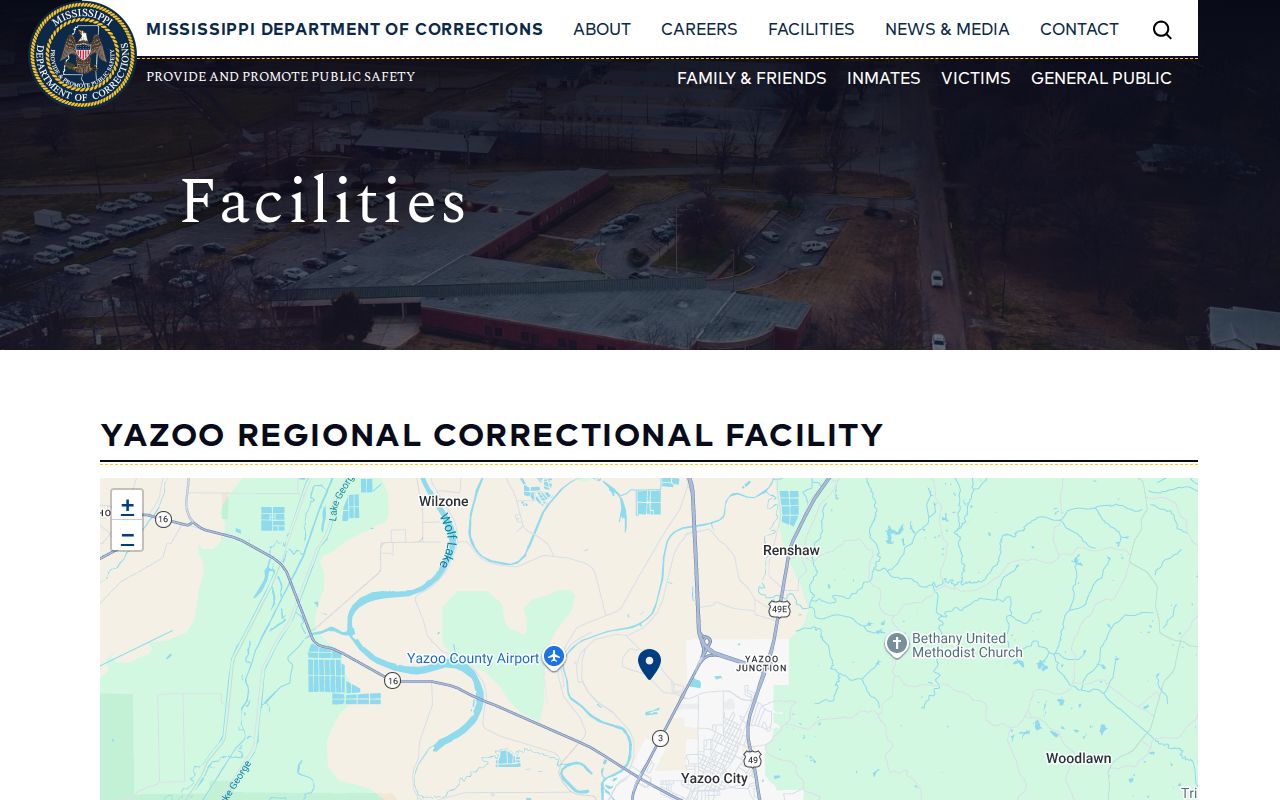
The source view confirms why both the Sheriff and MDOC can matter, while the person’s custody status decides which record controls.
Yazoo Facility Names Matter
Yazoo is not a one-jail county. The regional facility holds state prisoners under a county-operated agreement, Yazoo City maintains a small municipal holding area, and the federal complex has three current institution names. Old directories can add more confusion because the former Yazoo County Community Work Center closed in 2016.
Aliases should be treated as clues, not proof of current custody. The regional institution may appear as Yazoo County Regional Correctional Facility or Yazoo County Correctional Facility. Confirm the current official name, operator, and inmate number system before sending a request. The same discipline applies when an old record points to the closed work center or uses a federal name that has since changed.
Note: A familiar Yazoo building name does not establish whether the Sheriff, MDOC, BOP, or a court owns the requested record.
Yazoo Regional ICE Handoffs
No ICE detention facility was verified in Yazoo County. Even so, an immigration detainer can affect the end of a local or state custody episode. A detainer is a request from immigration authorities for notice and a brief hold so ICE can assume custody. It does not by itself prove that a person was later transferred, removed, or released.
If the Yazoo Regional record names ICE as the destination, describe the event as a handoff rather than a community release. Search the ICE Online Detainee Locator with the exact nine-digit A-number and country of birth, or exact biographical details. ICE says the locator covers current custody and may include some people released within the prior 60 days. Omissions and delays remain possible.
The Jackson check-in office serves Yazoo County but is not a detention center. If ODLS has no match, use the ICE detention reporting and case channels. A blank result cannot prove release, removal, or freedom, just as a missing county roster entry cannot prove a release from Yazoo Regional custody.
Read Yazoo Regional Records
Different records answer different questions. A filed court order supplies legal authority. The jail docket records the local movement. An MDOC detail page shows state sentence and location data. MS SAVIN can report a participating agency’s event, while the MDOC parolee search can show conditional supervision after state release. None should be stretched beyond its own scope.
| Record | Best use | Limit |
|---|---|---|
| Facility or Sheriff docket | How local custody ended | Does not compute an MDOC sentence |
| Court order | Why release or transfer was authorized | May precede the actual movement |
| MDOC search and time sheet | State location, sentence, and actual state event | Tentative date is not a promise |
| MS SAVIN | Agency-reported release or transfer notice | Must be read with the reporting agency |
A discharge ends a sentence or legal custody term. Parole and earned-release supervision are conditional placements that can keep the person under MDOC authority outside a prison. A transfer ends one facility’s custody but starts or continues another. Using those terms precisely prevents a movement record from being mislabeled as a final release.
For a local episode, Mississippi law gives the request a specific focus. The sheriff’s jail docket must preserve how the prisoner was released or discharged and the warrant or penitentiary officer’s receipt. Ask for that existing history instead of asking staff to create a new narrative. The county retention schedule describes booking records with discharge information and keeps the series for ten years after release. Retention does not mean Yazoo publishes a ten-year online archive. It means an old booking should be pursued through a narrow records request when no public roster remains.
For an MDOC prisoner, the public search shows useful fields but has limits. It can include the MDOC ID, current location and unit, location-change date, sentence details, conviction county, and the exact label “Tentative Release Date.” A tentative date is an estimate, not the actual exit. A missing result or blank location is also inconclusive. Request the time sheet, actual release type and date, discharge date, jail credit, and relevant location history from MDOC Records when those fields matter.
MS SAVIN adds a person-specific event channel for participating county and state systems. Read whether the notice reports release, transfer, return to custody, or escape. The Mississippi Registration Link can carry notification registration from county custody into MDOC or another participating system. That feature is especially useful at this hybrid facility because an agency transition might otherwise look like release home. Always confirm the alert with the office that entered the event.
If a court order and custody record seem to conflict, preserve each time. The signed or filed court order may come before staff authenticate it, check other holds, calculate time, process property, or arrange transport. Ask whether another cause, detainer, or receiving agency controlled the later movement. The filed order explains authority; the facility or MDOC movement record establishes what happened next.